The Groysman Method

Same symptom.
Different cause.

Long COVID is not one illness with one cause. Two people can share the same symptom for completely different reasons. The Groysman Method looks for the pattern underneath, matching your symptoms, triggers, and treatment response to the systems that are actually driving your illness.

6 Mechanisms
3 Models
1 Published paper
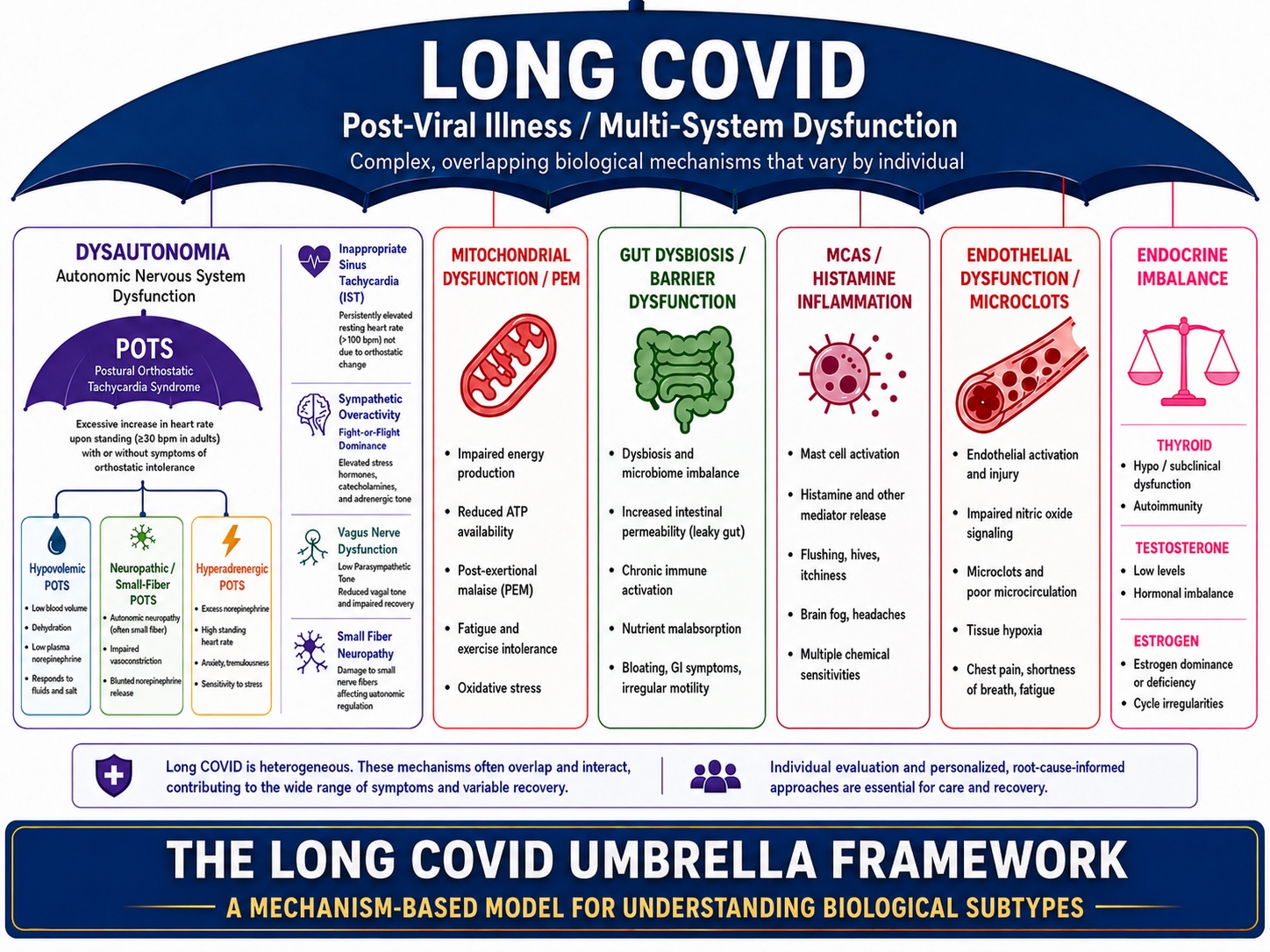
The Long COVID Umbrella Framework: dysautonomia, mitochondrial dysfunction, gut dysbiosis, MCAS, endothelial dysfunction, and endocrine imbalance shown as panels under one umbrella
The Long COVID umbrella: six mechanisms under one condition.

Your tests came back normal.
Your symptoms did not.

Many people with Long COVID are told their basic tests look fine. Some are handed treatments with no clear explanation of why those treatments were chosen. Long COVID is rarely a clean case of one diagnosis and one treatment. It is usually a pattern of disrupted systems, and two people carrying the same label can need very different care.

The method starts by changing the question. Not which diagnosis is this, but which systems are not functioning normally. To get there, it asks better questions.

The questions that change the answer

01

What makes your symptoms worse?

Triggers are clues. What reliably worsens a symptom often points to the system behind it.

02

Do they flare with standing, heat, meals, stress, activity, poor sleep, or certain foods?

Standing and heat point toward the autonomic nervous system. Foods can point toward mast cells or the gut.

03

Do you crash right away, or one to two days later?

A delayed crash points toward mitochondrial dysfunction and post-exertional malaise.

04

Does lying down help?

Relief when lying down points toward blood pressure and autonomic regulation.

05

Are your symptoms tied to blood pressure, heart rate, digestion, sleep, inflammation, or hormones?

Each connection narrows the search to a specific system.

06

Which system looks like the main driver?

The dominant pattern becomes the target for treatment.

Answer those, and the illness stops looking random. A pattern starts to show.

Three models for one complicated illness.

Each model looks at Long COVID from a different angle. Together they explain why it takes so many forms, how the clues fit, and why the body stops running well.

The Umbrella Model

Long COVID is not one disease. It is an umbrella syndrome.

Under the umbrella sit several biological mechanisms that overlap differently from one person to the next. That is why the condition can reach so many parts of the body, and why one treatment helps one person and does little for another. The useful question is not whether you have Long COVID. It is which parts of the umbrella are active in you.

The Puzzle Model

Each symptom, trigger, and test result is one puzzle piece.

Brain fog is one piece. A racing heart when you stand is another. A crash two days after activity is another. One piece alone rarely explains the whole illness. Set side by side, the pieces reveal a pattern. The goal is not to collect endless pieces or run every test. It is to find which pieces belong together.

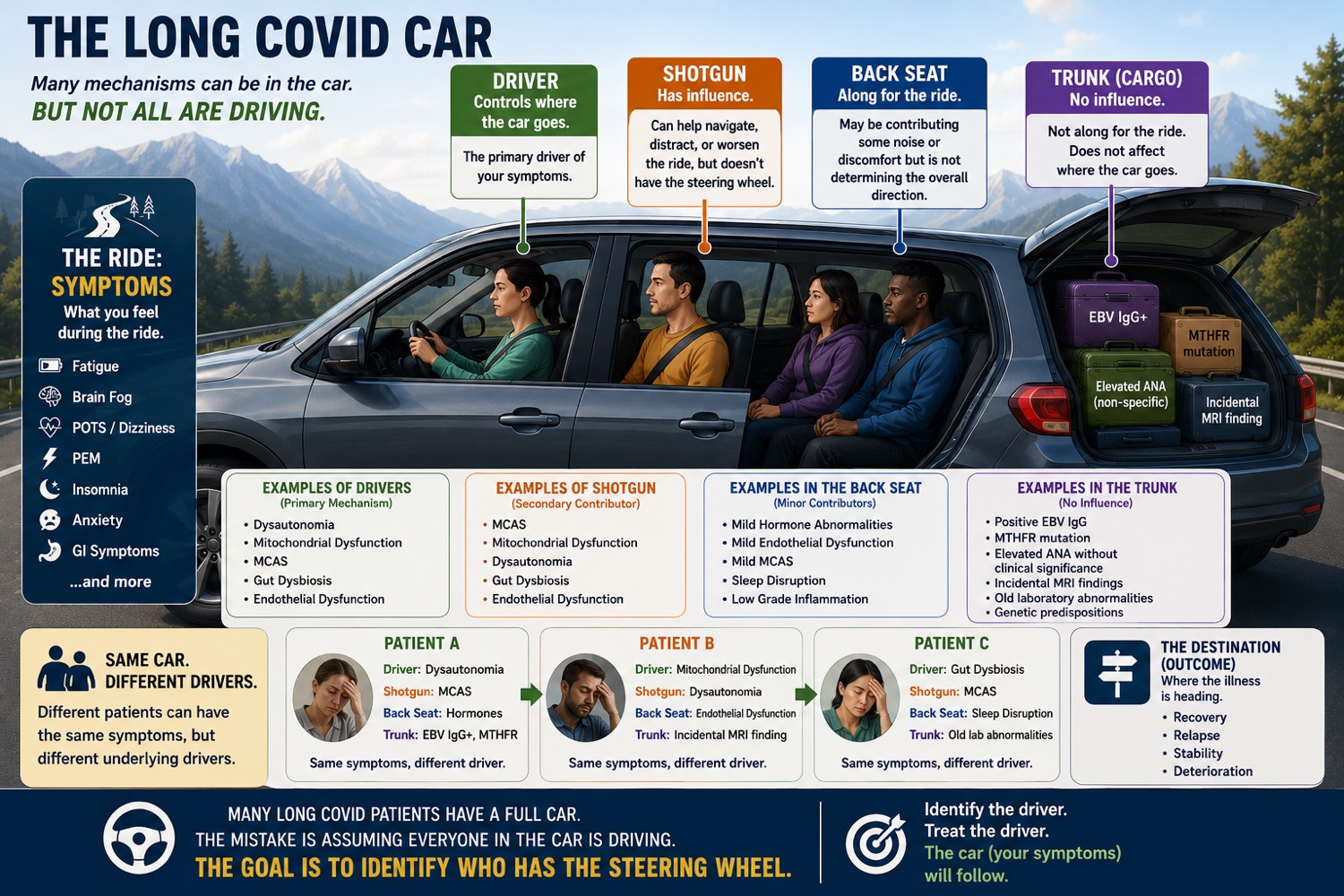
The Car Model

When a car runs poorly, the fault is not the same in every car.

One has a weak battery. Another has an engine problem. Another has a fuel or wiring fault. Your body works the same way. Mitochondria are the energy system. The autonomic nervous system is the autopilot. The gut is the processing and signaling system. Mast cells are the alarm cells. The blood vessels are the delivery line. Hormones and metabolism are the control signals. The work is finding which system needs attention.

The Long COVID Car analogy: the primary driving mechanism versus secondary contributing mechanisms, illustrated as driver, passenger, back seat, and trunk
The Car: which mechanism is in the driver's seat.

The Framework

Symptoms, triggers, timing, then the mechanism.

No single clue makes the diagnosis. The method reads them together in a fixed order, then follows the pattern to the care that fits it.

Symptoms What you feel. The starting point, not the answer.
Triggers Which stressors reliably destabilize the system.
Timing Whether the system fails during the stress, or later, in recovery.
Mechanisms The system that best explains the whole pattern.
Immediate

A regulation problem.

When symptoms hit right away during a trigger, the issue is usually how the body regulates itself in the moment: dysautonomia, postural orthostatic tachycardia syndrome (POTS), endothelial dysfunction, mast cell activation syndrome (MCAS), or a fight-or-flight state.

Delayed

A recovery problem.

When the crash lands 12 to 48 hours later, the pattern points toward post-exertional malaise (PEM) and mitochondrial dysfunction. The system does not fail during the effort. It fails while trying to recover from it.

Most people have more than one mechanism, but they are rarely equal. One usually drives most of the decline. Read the trigger and the timing together, and the dominant one starts to surface.

When this shows up Look first at
Standing brings on immediate dizziness, a racing heart, weakness, or brain fog Dysautonomia, POTS, or perfusion dysfunction
Exertion is followed by a delayed crash 12 to 48 hours later Mitochondrial dysfunction and post-exertional malaise
Meals bring bloating, fatigue, brain fog, reflux, or diarrhea Gut dysbiosis, small intestinal bacterial overgrowth (SIBO), histamine, or metabolic dysfunction
Heat, alcohol, leftovers, or fermented foods set off flushing, itching, or hives MCAS or histamine excess
Cold hands, purple feet, air hunger, chest discomfort, or low-flow symptoms on exertion dominate Endothelial or microvascular dysfunction
Symptoms shift with mornings, bedtime, temperature, the menstrual cycle, libido, weight, or metabolism Hormone or neuroendocrine dysfunction
Internal vibration, adrenaline surges, tremor, insomnia, or a wired-but-tired state dominate Fight-or-flight or sympathetic overdrive

These are starting directions, not verdicts. The dominant pattern is where treatment begins, and it is checked against how you respond.

What goes in

Symptoms, triggers, timing, medical history, physical findings, testing when appropriate, and how you respond to treatment.

What it points to

The dominant mechanism, the system that best explains the pattern in front of you.

What it guides

Targeted care matched to that mechanism, rather than a treatment chosen at random.

The Six Mechanisms

Six mechanisms drive most of Long COVID.

The method organizes the illness around six root mechanisms. Most patients have more than one, which is why care is matched to the person, not the label. Each one is covered in depth across the handbook.

01

Dysautonomia

Dysfunction of the autonomic nervous system, which controls heart rate, blood pressure, digestion, and temperature without conscious effort.

What it may look likeRacing heart on standing, dizziness, palpitations, heat intolerance, blood pooling, adrenaline surges, internal vibration, insomnia, near-fainting.

Why it is plausibleLong COVID is associated with autonomic symptoms, and POTS-like syndromes after COVID are described in the medical literature.

02

Mitochondrial Dysfunction

Impaired energy production at the cellular level. When mitochondria cannot make enough ATP, fatigue and post-exertional malaise follow.

What it may look likeDelayed crashes, post-exertional malaise, heavy limbs, poor recovery, brain fog that worsens a day or two after activity.

Why it is plausibleLong COVID patients with post-exertional malaise have shown skeletal muscle abnormalities, reduced exercise capacity, and worsening after an exertion challenge.

03

Endothelial Dysfunction

Vascular injury and microclot formation that impair blood flow and oxygen delivery, driving symptoms that resist conventional treatment.

What it may look likeCold hands and feet, air hunger, chest discomfort with a normal workup, mottled skin, Raynaud-like changes, cognitive slowing.

Why it is plausibleReviews describe endothelial dysfunction, platelet activation, and fibrinaloid microclots as plausible contributors in a subset of patients.

04

Gut Dysbiosis

Imbalance of the gut microbiome and breakdown of the intestinal barrier, which affects immunity, inflammation, and nutrient absorption.

What it may look likeBloating, reflux, diarrhea or constipation, new food intolerances, brain fog after meals, histamine flares.

Why it is plausibleA randomized, double-blind, placebo-controlled trial of the synbiotic SIM01 improved multiple post-acute COVID symptoms, supporting the gut as a real target.

05

MCAS & Histamine

Immune alarm cells release excess histamine, triggering flushing, food reactions, and unpredictable flares.

What it may look likeFlushing, itching, hives, food and chemical sensitivity, a racing heart after meals, reflux, nasal symptoms, poor sleep.

Why it is plausibleLong COVID patients can show mast cell activation patterns, and H1 and H2 antihistamine blockade has shown benefit in observational Long COVID data.

06

Hormone Imbalance

Disruptions in thyroid, cortisol, sex hormones, and metabolism that compound fatigue, cognitive symptoms, and poor recovery.

What it may look likeLow-thyroid pattern, cold intolerance, low cortisol pattern, worsening around the menstrual cycle or perimenopause, metabolic and sleep changes.

Why it is plausibleImmune-profiling studies have found hormonal differences in Long COVID, including lower cortisol. COVID has also been linked to thyroid dysfunction.

Testing

Targeted labs, not a catalog.

More testing is not always better medicine. The method does not ignore labs. It uses them more carefully. The CDC notes that no laboratory test can definitively diagnose or rule out Long COVID, and that routine blood tests, chest X-rays, and electrocardiograms may be normal in someone who is clearly unwell. [1, 2]

Normal routine labs do not automatically mean nothing is wrong. Long COVID is often a regulation problem rather than a single-organ failure, and a system that is mis-regulating will not always leave a mark on a standard panel.

~64% chance of at least one abnormal result across a 20-test panel

Most reference ranges are built around the middle 95% of a healthy population. About 5% of healthy people fall outside the range on any given test, even when nothing is truly wrong. Order enough tests and the odds compound. A false positive is not harmless. It can lead to more testing, referrals, worry, and treatment aimed at the wrong thing. [28, 29]

So labs are ordered to answer a specific question, not to go fishing:

  • Rule out Dangerous or treatable mimics: anemia, thyroid disease, diabetes, autoimmune or cardiopulmonary disease, infection, and medication effects.
  • Confirm A suspected mechanism, using endothelial, hormone, gut, inflammatory, or nutrient markers when the pattern already points somewhere.
  • Stage How severe a mechanism is, which decides conservative support versus escalation.
  • Guide How intensively to treat, so the plan matches the size of the problem.
  • Monitor Safety over time: kidney and liver function, blood counts, clotting risk, electrolytes, hormones, and glucose.

The lab strategy follows the mechanism. The mechanism is not invented after scanning a long list of abnormal values. [1, 3, 28, 30]

Neuromodulation Tools

Tools for the nervous system, used by pattern.

Some patterns involve abnormal signaling between the nervous system, the immune system, and the vascular system. A few procedures target that signaling directly. Each is used for a specific pattern, and each is presented with its evidence, including where the evidence is mixed or still early.

Stellate Ganglion Block

SGB

TargetsThe cervical sympathetic chain.

Considered when the pattern points to broad sympathetic overdrive: adrenaline surges, internal vibration, hyperadrenergic dysautonomia, insomnia, or panic-like physiology. A small retrospective cohort of 41 Long COVID patients reported that 86% experienced symptom reduction after SGB. With no control group, it is promising but not definitively proven. [20] The evidence is not uniform. A randomized trial for COVID-induced parosmia found SGB was not superior to placebo for that single indication. [21] SGB is best understood as a sympathetic-regulation tool for selected patients, not a universal procedure.

Epipharyngeal Abrasive Therapy

EAT

TargetsChronic inflammation in the epipharynx, the area behind the nasal cavity and upper throat.

Most relevant when symptoms suggest upper-airway inflammation, chronic throat or postnasal symptoms, or vagal irritation. A 2022 observational study of 58 Long COVID patients reported reduced epipharyngeal inflammation and improved fatigue, headache, and attention. [22] A 2025 study using spatial transcriptomics found residual SARS-CoV-2 signaling in the epipharynx and proposed that EAT may work by modulating local inflammation. [23] It has not been tested in large randomized trials.

Vagus Nerve Stimulation

VNS

TargetsVagal signaling into brainstem autonomic networks.

Ear-based transcutaneous auricular VNS is usually preferred as a first step because it is non-invasive. Functional MRI shows that stimulating the auricular branch of the vagus nerve can activate the nucleus tractus solitarius, the first relay station for vagal signals. [25] A 2024 pilot study of 24 women with Long COVID reported improvements in cognition, anxiety, depression, and sleep. [26] The evidence is still early: a sham-controlled pilot for Long COVID fatigue found the approach feasible and safe, but active stimulation did not clearly outperform sham. [27] A systematic review found it generally safe, with side effects such as ear pain, headache, and tingling. [31]

Honest Limits

What we do, and do not, claim.

We do not claim

  • that every Long COVID patient needs the same protocol.
  • that SGB works for everyone.
  • that EAT is proven by large multicenter randomized trials.
  • that VNS cures Long COVID.
  • that supplements cure Long COVID.
  • that every abnormal lab is the cause of symptoms.
  • that antiplatelet or anticoagulant therapy is appropriate for every patient with Long COVID.

What we do claim

Long COVID patients deserve a structured, mechanism-based evaluation rather than being dismissed, mislabeled, or treated with a one-size-fits-all plan.

Evidence

References

These references support the mechanism-based structure of the method, the case for targeted testing, and the evidence framing for procedures. They do not imply that every treatment is proven for every patient. The framework is set out in full in a published Hypothesis and Theory paper, Long COVID as a network disorder, in Frontiers in Medicine (2026). DOI: 10.3389/fmed.2026.1841690.

  1. 1 CDC. Long COVID Clinical Guidance. Centers for Disease Control and Prevention. Updated March 9, 2026. View source ↗
  2. 2 CDC. Long COVID Signs and Symptoms. Centers for Disease Control and Prevention. Updated March 9, 2026. View source ↗
  3. 3 Lewthwaite H, et al. Treatable traits for long COVID. Respirology. 2023. View source ↗
  4. 4 Peluso MJ, et al. Mechanisms of long COVID and the path toward therapeutics. Cell. 2024. View source ↗
  5. 5 Fedorowski A, et al. Autonomic dysfunction and postural orthostatic tachycardia syndrome in post-acute COVID-19 syndrome. Nature Reviews Cardiology. 2023. View source ↗
  6. 6 Pierson BC, et al. Oral medications for the treatment of postural orthostatic tachycardia syndrome: A systematic review of studies before and during the COVID-19 pandemic. Frontiers in Neurology. 2025. View source ↗
  7. 7 Appelman B, et al. Muscle abnormalities worsen after post-exertional malaise in long COVID. Nature Communications. 2024. View source ↗
  8. 8 Hansen KS, et al. High-dose coenzyme Q10 therapy versus placebo in patients with post COVID-19 condition: A randomized, phase 2, crossover trial. The Lancet Regional Health Europe. 2023. View source ↗
  9. 9 Wu CY, et al. Effects of nicotinamide riboside on NAD+ levels, cognition, and symptom recovery in long-COVID: A randomized controlled trial. EClinicalMedicine. 2025. View source ↗
  10. 10 Slankamenac J, et al. Effects of six-month creatine supplementation on patient- and tissue-level bioenergetics in post-COVID-19 fatigue syndrome. Food Science & Nutrition. 2023. View source ↗
  11. 11 Liu S, et al. Effect of urolithin A supplementation on muscle endurance and mitochondrial health in older adults: A randomized clinical trial. JAMA Network Open. 2022. View source ↗
  12. 12 Lau RI, et al. A synbiotic preparation (SIM01) for post-acute COVID-19 syndrome in Hong Kong: A randomised, double-blind, placebo-controlled trial. The Lancet Infectious Diseases. 2024. View source ↗
  13. 13 Weinstock LB, et al. Mast cell activation symptoms are prevalent in Long-COVID. International Journal of Infectious Diseases. 2021. View source ↗
  14. 14 Salvucci F, et al. Antihistamines improve cardiovascular manifestations and other symptoms of long-COVID attributed to mast cell activation. Frontiers in Cardiovascular Medicine. 2023. View source ↗
  15. 15 Pretorius E, et al. Persistent clotting protein pathology in Long COVID/Post-Acute Sequelae of COVID-19. Cardiovascular Diabetology. 2021. View source ↗
  16. 16 Kell DB, Pretorius E. The potential role of ischaemia-reperfusion injury in chronic, relapsing diseases such as Long COVID. Biochemical Journal. 2022. View source ↗
  17. 17 Tosato M, et al. L-arginine plus vitamin C improves physical performance, endothelial function, and fatigue in adults with Long COVID: A randomized clinical trial. Nutrients. 2022. View source ↗
  18. 18 Klein J, et al. Distinguishing features of Long COVID identified through immune profiling. Nature. 2023. View source ↗
  19. 19 Anbardar N, et al. Thyroid disorders and COVID-19: A comprehensive review of literature. Frontiers in Endocrinology. 2025. View source ↗
  20. 20 Pearson L, et al. Stellate ganglion block relieves Long COVID-19 symptoms in 86% of patients: A retrospective cohort study. Cureus. 2023. View source ↗
  21. 21 Farrell NF, et al. Stellate ganglion block for the treatment of COVID-19-induced parosmia: A randomized clinical trial. JAMA Otolaryngology-Head & Neck Surgery. 2025. View source ↗
  22. 22 Imai K, et al. Epipharyngeal abrasive therapy has potential as a novel method for Long COVID treatment. Viruses. 2022. View source ↗
  23. 23 Nishi K, et al. Spatial transcriptomics of the epipharynx in Long COVID identifies SARS-CoV-2 signalling pathways and the therapeutic potential of epipharyngeal abrasive therapy. Scientific Reports. 2025. View source ↗
  24. 24 Khan MWZ, et al. Vagal nerve stimulation for the management of Long COVID symptoms. Infect Med (Beijing). 2024;3(4):100149. View source ↗
  25. 25 Yakunina N, et al. Optimization of transcutaneous vagus nerve stimulation using functional MRI. Neuromodulation. 2017. View source ↗
  26. 26 Zheng ZS, et al. Transcutaneous vagus nerve stimulation improves Long COVID symptoms in a female cohort: A pilot study. Frontiers in Neurology. 2024. View source ↗
  27. 27 Gierthmuehlen M, et al. Transcutaneous auricular vagal nerve stimulation against fatigue syndrome in patients with Long COVID: Results of the randomized placebo-controlled clinical pilot trial COVIVA. 2026. View source ↗
  28. 28 Naugler C, et al. More than half of abnormal results from laboratory tests ordered by family physicians could be false-positive. Canadian Family Physician. 2018. View source ↗
  29. 29 Smellie WSA. When is abnormal abnormal? Dealing with the slightly out of range laboratory result. Journal of Clinical Pathology. 2006. View source ↗
  30. 30 National Academies of Sciences, Engineering, and Medicine. Improving Diagnosis in Health Care. 2015. View source ↗
  31. 31 Kim AY, et al. Safety of transcutaneous auricular vagus nerve stimulation (taVNS): A systematic review and meta-analysis. Scientific Reports. 2022;12:22055. View source ↗
  32. 32 NICE. COVID-19 rapid guideline: Managing the long-term effects of COVID-19, Evidence review C: Investigations. 2021. View source ↗
  33. 33 Choosing Wisely Canada. Using Labs Wisely. View source ↗

The thinking behind the method is laid out in a published Hypothesis and Theory paper. It proposes Long COVID as a network disorder: six primary mechanism domains coupled with secondary amplifying processes, including immune activation and sleep disruption, that can keep the loops running. It is a proposed model, offered for patients and clinicians to weigh against what they see.

Read the research

Where to Start

Understand your pattern.

The six mechanisms are covered in depth across the handbook series. Start there to learn which ones may be driving your symptoms and what tends to help.